

What Ecommerce Price Monitoring Is (And Isn’t)
In a marketplace where competitor prices change millions of times per day, the gap between knowing and not knowing a competitor’s price move is measured in margin and market share. This guide covers everything an ecommerce pricing team needs to build a systematic price monitoring capability — from scoping which products and competitors to track, to configuring alert logic, building response workflows, and calculating the ROI of the investment
What’s the use of an ecommerce price monitoring tool? Such tools help monitor competitors’ prices, enabling retailers to adjust their pricing strategies accordingly and ensuring they offer customers the best deals possible.
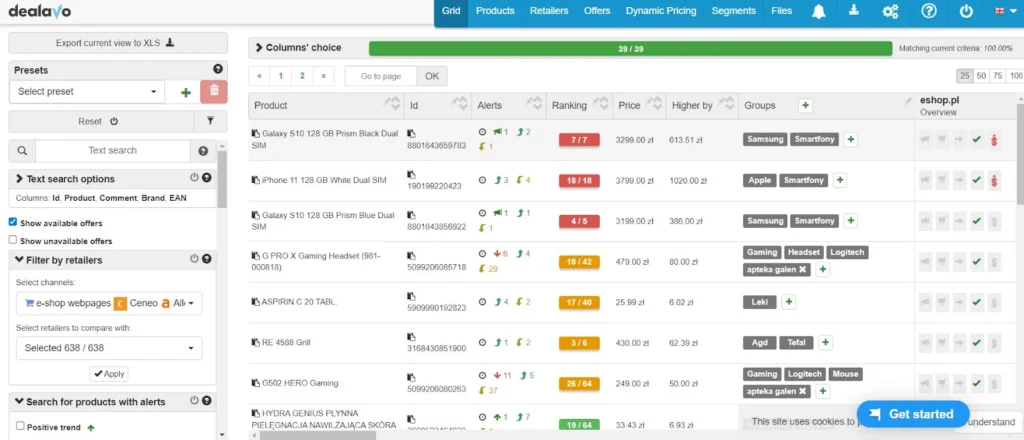
Image Source: Dealavo
However, with so many options available, finding the perfect e-commerce price monitoring tool can be overwhelming. Let’s look at a few ways to choose the best platform suited for your needs.
Ecommerce Price Monitoring: The Complete Guide to Setup, Alerts, ROI and Tool Selection
Before evaluating tools, it’s essential to understand exactly what ecommerce price monitoring entails—and just as importantly, what it doesn’t.
What Ecommerce Price Monitoring IS
Ecommerce price monitoring is the systematic, automated tracking of product prices across online retail channels to inform strategic pricing decisions. It provides visibility into:
- Competitor pricing: How your competitors price identical or comparable products
- Market positioning: Where your prices sit relative to the market average
- Pricing trends: How prices fluctuate over time (seasonal, promotional, cyclical)
- Promotional activity: When and how competitors discount
- Price gaps: Opportunities to adjust prices for margin or volume optimization
Primary Business Objectives:
- Optimize pricing for revenue and margin
- Understand competitive landscape
- Identify market opportunities
- Support strategic planning (assortment, positioning, promotions)
What Ecommerce Price Monitoring IS NOT
| Often Confused With | Key Difference |
| MAP Monitoring | MAP monitoring software tracks your own retailers for compliance with your pricing policies. Price monitoring tracks competitors to inform your strategy. They serve different purposes and often require different tools. |
| Dynamic Repricing | Price monitoring provides intelligence; dynamic repricing strategy is the action of automatically changing prices based on rules. Monitoring informs repricing but is not the same thing. |
| Competitor Spying | Price monitoring is ethical, automated data collection from public sources—not industrial espionage. It’s standard competitive intelligence. |
| Manual Price Checking | Automated monitoring replaces the impossible task of manually checking hundreds of sites with systematic, continuous data collection. |
The Relationship: Price Monitoring vs. MAP Monitoring
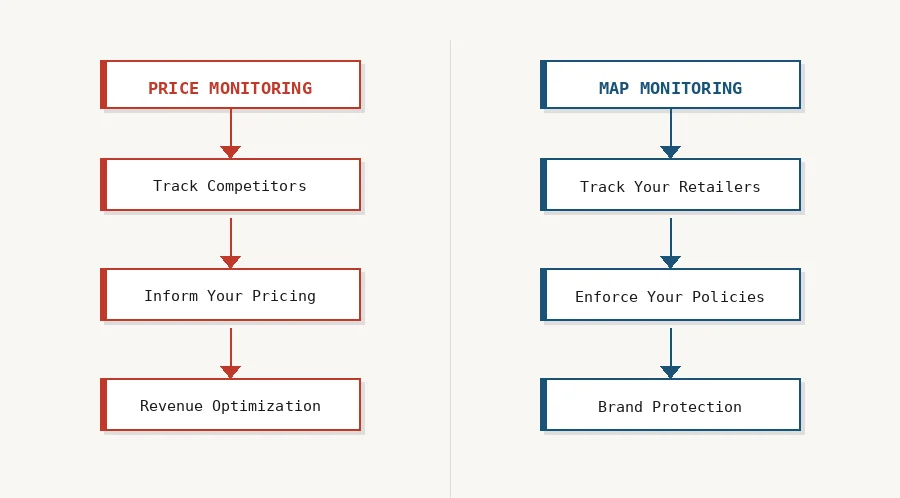
Both are essential. Price monitoring helps you win; MAP monitoring ensures you don’t lose.
How to Implement Ecommerce Price Monitoring
Implementing price monitoring isn’t just about buying software—it’s about building a system that delivers actionable intelligence. Here’s the step-by-step implementation framework.
Step 1: Define Your Monitoring Scope
Which Products to Monitor:
- Tier 1 (Core SKUs): 20% of products driving 80% of revenue → monitor daily or real-time
- Tier 2 (Secondary): Regular products with moderate volume → monitor weekly
- Tier 3 (Long-tail): Low-volume or seasonal → monitor monthly or on-demand
Which Competitors to Track:
| Competitor Type | Examples | Priority | Cadence |
| Direct Competitors (Same Products) | Other sellers of identical branded items | CRITICAL | Daily |
| Category Competitors (Similar Products) | Competitors offering comparable alternatives | HIGH | Weekly |
| Market Leaders | Amazon, Walmart, category giants | HIGH | Daily |
| Regional/Local | Competitors in specific geographies | MEDIUM | Weekly |
| Emerging/Niche | New entrants, specialists | LOW | Monthly |
Which Data Points to Capture:
| Data Point | Why It Matters | Priority |
| Listed Price | Core metric | CRITICAL |
| Promo Price | Discounts, flash sales | CRITICAL |
| Stock Status | Out-of-stock = opportunity | HIGH |
| Seller Name | Who’s selling | HIGH |
| Product Variants | Different sizes/colors may have different prices | MEDIUM |
| Reviews/Ratings | Context for price positioning | MEDIUM |
| Shipping Cost | Total landed price | MEDIUM |
| Coupon Availability | Hidden discounts | MEDIUM |
Step 2: Determine Data Sources
| Source Type | Examples | Coverage | Complexity |
| Major Marketplaces | Amazon, eBay, Walmart, Target | High | Medium |
| Competitor Websites | Direct-to-consumer sites | High | High (many sites) |
| Price Comparison Engines | Google Shopping, Shopzilla, PriceGrabber | Medium | Low |
| Social Commerce | Facebook Marketplace, Instagram Shops | Growing | High |
| International Sites | Regional marketplaces | Varies | High |
Step 3: Configure Crawl Frequency
Real-Time Ecommerce Price Tracking (Multiple times per day)
- For: Core SKUs, highly competitive categories, fast-moving products
- Why: Price changes happen fast; response time matters
- Example: Electronics, trending items, holiday season
Daily Monitoring
- For: Most SKUs, standard categories
- Why: Sufficient for regular pricing decisions
- Example: Apparel, home goods, consumer packaged goods
Weekly Monitoring
- For: Long-tail, stable categories, low-velocity items
- Why: Less frequent changes; lower priority
- Example: Specialty items, slow movers
On-Demand Monitoring
- For: Ad-hoc analysis, specific investigations
- Why: Flexibility for special projects
- Example: New competitor entry, promotional planning
Step 4: Set Alert Logic
Alerts should be actionable, not noisy. Configure thresholds that matter with product price alerts.
Price Drop Alerts:
- Alert when competitor price drops below X% of your price
- Alert when price drops below MAP (if tracking own retailers)
- Alert when price hits all-time low
Stock Alerts:
- Alert when competitor is out of stock (your opportunity)
- Alert when competitor restocks
New Product Alerts:
- Alert when competitor launches new SKU in your category
Promotion Alerts:
- Alert when competitor starts a flash sale
- Alert when competitor offers coupon codes
Step 5: Establish Response Workflow
ALERT → TRIAGE → ANALYZE → DECIDE → ACT → MEASURE
| Step | Owner | Timeline | Output |
| Alert | Automated | Instant | Notification with key details |
| Triage | Pricing Analyst | < 1 hour | Confirm alert is valid; check context |
| Analyze | Pricing Manager | 1-4 hours | Assess impact; model options |
| Decide | Category Lead | 4-24 hours | Choose response (reprice, hold, promote) |
| Act | Ecommerce Ops | 24 hours | Implement price change |
| Measure | Revenue Analyst | Weekly | Track impact on sales and margin |
Ready to calculate what price monitoring could return for your specific catalogue?Schedule a demo today and we’ll show you live price monitoring across your competitive set and help you model the margin impact for your category.
Defining Your Business Requirements Before Choosing a Price Monitoring Tool
Before diving into the world of price monitoring tools, it’s crucial to understand your business needs.
Consider the following questions for your ecommerce price monitoring tool:
What type of products do you sell? (e.g., electronics, fashion, home goods)
- What specific industry or vertical does your business operate in (e.g., consumer electronics, luxury fashion, sustainable home goods)?
- Are your products physical goods, digital products, or services?
- Do you sell niche or specialty products (e.g., organic skincare, smart home devices, industrial equipment)?
- Are there subcategories or seasonal products we should prioritize (e.g., winter apparel, gaming accessories)?
How many competitor websites do you want to track?
- How many competitor websites/apps do you aim to monitor initially (e.g., 5–10, 50+)?
- Do you already have a list of competitors, or would you like assistance identifying them?
- Should the tool focus on direct competitors (similar products/price ranges) or also include indirect competitors (e.g., substitutes, broader market players)?
- Are there regional or global competitors to prioritize (e.g., tracking local vs. international brands)?
Do you need real-time updates or periodic reports with your ecommerce price monitoring tool?
- Do you require real-time alerts (e.g., for price drops, stock changes, flash sales) or daily/weekly summaries?
- For periodic reports: What cadence works best (daily, weekly, monthly)?
- Should reports include visual dashboards, raw data exports (CSV/Excel), or both?
- Are there specific metrics to highlight (e.g., pricing trends, promotional activity, customer reviews)?
Are you interested in tracking specific product categories or brands?
- Should the tool focus on specific product categories (e.g., smartphones, athleisure wear) or brands (e.g., Apple, Nike)?
- Do you want to track competitor product launches, discontinuations, or stock availability?
- Are you interested in monitoring private-label competitors or emerging brands?
- Should we exclude any irrelevant brands/categories to reduce noise?
Does the tool need to integrate with your existing systems?
- Do you need the tool to integrate with existing platforms (e.g., ERP, CRM, inventory management, BI tools)?
- Are there preferred APIs or formats (e.g., JSON, XML) for data synchronization?
- Does your team require pre-built connectors (e.g., Shopify, Google Analytics, Tableau)?
- Are there security or compliance protocols (e.g., GDPR, encryption) the tool must adhere to?

Image Source: Gelato
Answering these questions will help narrow down your choices and find a solution tailored to your unique requirements.
Key Features to Look For in a Price Monitoring Tool
When evaluating different e-commerce price monitoring tools, consider the following features:
- Accuracy: A reliable tool should provide accurate and up-to-date information about competitors’ prices. Ensure the tool uses advanced algorithms and web scraping techniques to gather data from various sources.
- Customization: Look for a tool that allows you to customize alerts based on specific criteria such as price changes, stock levels, and new product listings.
- Integration: Seamless integration with your current e-commerce platform, inventory management system, or CRM is vital for efficient workflows and data analysis.
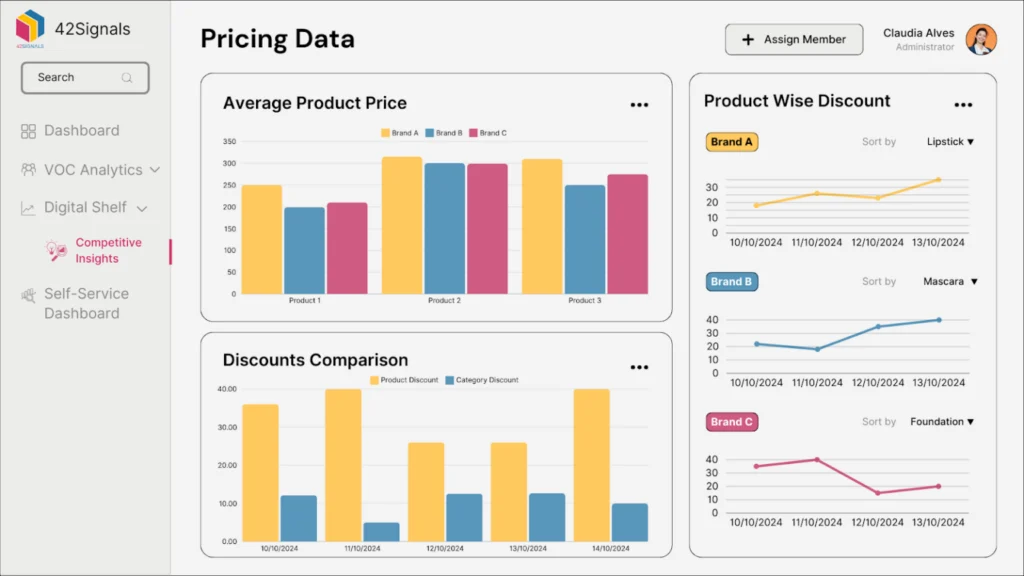
- Reporting: Comprehensive reporting capabilities enable you to analyze trends, identify opportunities, and make informed decisions. Opt for a tool that offers visual representations of data, exportable reports, and historical price comparisons.
- User Experience: An intuitive user interface ensures easy navigation and reduces the learning curve for users. Additionally, responsive customer support guarantees assistance when needed.
- Scalability: As your business grows, so too might your pricing needs. Choose a tool capable of scaling alongside your enterprise without compromising performance or accuracy.
- Security: Protect sensitive business information by selecting a tool that adheres to strict security standards and follows ethical practices regarding data collection and storage.
- Pricing: Finally, consider the cost of each tool relative to its value proposition. Balance affordability with functionality to maximize ROI.
Tool Evaluation Criteria: The Rubric Most Listicles Skip
Most “best tools” articles compare features. Smart buyers evaluate against a structured rubric tailored to their business. Here’s the framework used by professional pricing teams.
The Pricing Monitoring Scorecard (Weighted by Priority)
| Category | Criteria | Weight | What to Look For |
| Coverage | Competitor site coverage | 15% | Can they monitor all your target competitors? How many total sites? |
| Marketplace coverage | 10% | Amazon, eBay, Walmart, regional marketplaces | |
| International capability | 5% | Multi-currency, multi-language, geo-specific | |
| Data Quality | Accuracy | 15% | Match rate >95%; ask for audit results |
| Freshness | 10% | Update frequency matches your needs | |
| Historical depth | 5% | How long is data retained? Can you analyze trends? | |
| Usability | Dashboard intuitiveness | 5% | Can non-technical users navigate? |
| Alert configuration | 5% | Flexible rules, easy setup | |
| Report customization | 5% | Export options, visualizations | |
| Integration | API availability | 5% | Can data feed into your systems? |
| Platform connectors | 5% | Shopify, Magento, ERP, BI tools | |
| Support | Onboarding | 5% | Training, documentation, implementation help |
| Ongoing support | 5% | Response times, account management | |
| Value | Pricing model | 5% | Transparent pricing; scales with you |
| ROI justification | 5% | Can they help model potential returns? |
Scoring Template
Create a simple spreadsheet with:
Tool Name | Coverage (15) | Accuracy (15) | Freshness (10) | … | TOTAL (100)
Score each tool 1-5 per criterion, multiply by weight, sum total. Compare objectively.
Red Flags to Watch For
| Red Flag | Why It Matters |
| Can’t name specific competitors they monitor | Coverage claims may be exaggerated |
| No sample data or trial | Hiding poor quality |
| Long-term contract required upfront | Lack confidence in retention |
| Vague about update frequency | “Regular updates” could mean weekly or monthly |
| No API or export options | Data trapped in their system |
| Poor match rates | 80-90% means 10-20% of products are missed |
Pricing Alert Workflow: From Signal to Action
A price alert is useless without a workflow to act on it. Here’s how to build a system that turns alerts into profitable decisions.
Alert Threshold Logic
Absolute Thresholds:
- Alert when competitor price < $X (your cost + minimum margin)
- Alert when competitor price < your price by $Y
Relative Thresholds:
- Alert when competitor price < your price by X%
- Alert when competitor price drops >Y% in 24 hours
Contextual Thresholds:
- Alert only for top 20% of SKUs (by revenue)
- Alert only for specified “key competitors”
- Suppress alerts during promotional windows
Competitor Exclusions
Not every competitor matters equally. Configure exclusions to reduce noise:
| Exclusion Type | Rationale |
| Out-of-business/Inactive | No longer relevant |
| Consistently non-competitive | Never a threat; ignore |
| Different market segment | Luxury vs. budget; not comparable |
| Geographic mismatch | Only ships to regions you don’t serve |
| Temporary flash sales | May not warrant response |
Promotional Window Suppression
During planned promotions, suppress alerts to avoid false urgency:
| Scenario | Alert Setting |
| Black Friday week | Suppress all price drop alerts; monitor for intel only |
| Your planned promotion | Suppress alerts; you already have a strategy |
| Competitor flash sale | Keep alerts; may require response |
| Seasonal clearance | Monitor but hold response unless strategic |
Alert Routing Matrix
| Alert Type | Severity | Primary Recipient | Secondary | Response SLA |
| Price drop – Core SKU | HIGH | Pricing Manager | Category Lead | 4 hours |
| Price drop – Secondary | MEDIUM | Pricing Analyst | Category Lead | 24 hours |
| Price drop – Long-tail | LOW | Pricing Analyst | – | Weekly review |
| Competitor out of stock | HIGH | Category Lead | Marketing | 24 hours (opportunity) |
| New product launch | MEDIUM | Category Lead | Product Team | Weekly review |
| Promotion start | MEDIUM | Marketing | Pricing | 24 hours |
The 4-Hour Response Protocol (For Critical Alerts)
Hour 1: Triage & Verify
- Confirm alert is valid (not a data error)
- Check stock status (yours and competitor’s)
- Review recent pricing history
Hour 2: Analyze Impact
- Model margin impact of matching vs. holding
- Consider brand positioning implications
- Check for patterns (is this a trend or one-off?)
Hour 3: Decide
- Option A: Match price (defend share)
- Option B: Hold price (protect margin, trust brand)
- Option C: Partial match (meet halfway)
- Option D: Promote differently (bundle, value-add)
Hour 4: Execute
- Implement price change if decided
- Document decision and rationale
- Set follow-up to measure impact
ROI Framing: The Business Case for Price Monitoring
Price monitoring isn’t a cost—it’s an investment with measurable returns. Here’s how to frame the business case.
Margin Protection
The Problem: Without monitoring, you’re flying blind. Competitors undercut you, and you lose sales or erode margin responding reactively.
The ROI: Price monitoring with retail price intelligence enables you to:
- Maintain optimal margins on non-competitive items
- Respond strategically only when necessary
- Avoid blanket discounts that destroy profit
Example Calculation:
| Metric | Without Monitoring | With Monitoring |
| Average Margin | 35% | 38% |
| Annual Revenue | $10M | $10M |
| Gross Profit | $3.5M | $3.8M |
| Margin Lift | – | +$300,000 |
Just 3% margin improvement on $10M revenue adds $300K to bottom line.
Competitive Response Time
The Problem: Delayed response to competitor price benchmarking changes means lost sales. Every hour a competitor is cheaper, you lose conversions.
The ROI: Faster response captures sales that would have gone to competitors.
Example Calculation:
| Scenario | Response Time | Lost Sales/Week | Annualized |
| Manual monitoring | 72 hours | $2,000 | $104,000 |
| Automated alerts | 4 hours | $200 | $10,400 |
| Savings | – | $1,800/week | $93,600 |
Stockout Detection
The Problem: When competitors run out of stock, customers come to you—but only if you know about it and can capture demand.
The ROI: Monitoring competitor stockouts with stock availability analytics lets you:
- Capture displaced demand
- Potentially increase prices temporarily (supply/demand)
- Adjust marketing to highlight availability
Example: A key competitor is out of stock on a popular item for 3 days. You capture an additional $15,000 in sales that would have gone to them.
Opportunity Identification
Price monitoring reveals gaps in the market:
- Products competitors don’t stock → assortment opportunities
- Price gaps where you can increase margin
- Promotional patterns to inform your calendar
ROI Summary Table
| Benefit | Impact | Measurement |
| Margin Protection | +2-5% margin | Compare margin before/after |
| Faster Response | 50-80% reduction in response time | Track response SLA |
| Stockout Capture | 5-15% incremental sales during outages | Monitor stockout periods |
| Opportunity ID | New revenue streams | Track new initiatives |
| Time Savings | 10-20 hours/week | Calculate labor cost recovered |
Why 42Signals for Ecommerce Price Monitoring: Five Capabilities That Differentiate
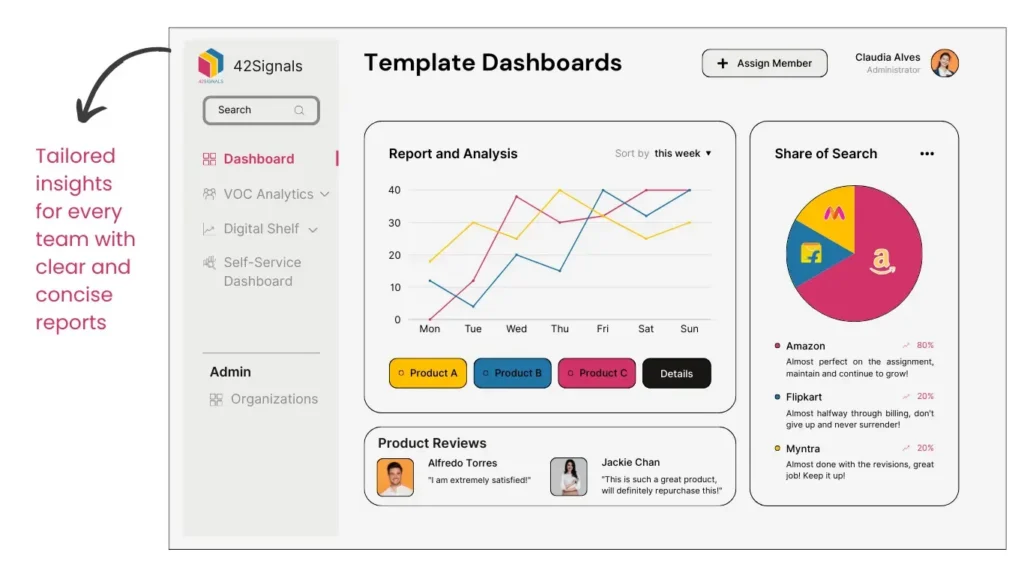
Let’s get into why 42Signals is a frontrunner with its impressive suite of features and unwavering dedication to customer satisfaction. Here are 5 reasons why –
Real-Time Market Intelligence
One of the most notable aspects of 42Signals is its ability to deliver real-time market data, empowering businesses to remain nimble amidst constant fluctuations in the e-commerce ecosystem via digital shelf analytics.
Its sophisticated algorithms continuously scan e-commerce marketplaces, gathering relevant information about competitor pricing, product availability, and consumer sentiment. By furnishing stakeholders with instantaneous insights, 42Signals MAP violation monitoring systems enable prompt decision-making, ensuring that companies never fall behind the curve.
Advanced Anti-Bot Measures
Navigating through anti-scraping technologies employed by competitors can often prove challenging for price monitoring tools. However, 42Signals has risen above this obstacle by employing adaptive data collection methods designed to circumvent even the most stringent countermeasures.
Businesses utilizing 42Signals benefit from reliable and consistent market insights that help identify key selling points, features, and benefits of listed products.
Accessible User Interface
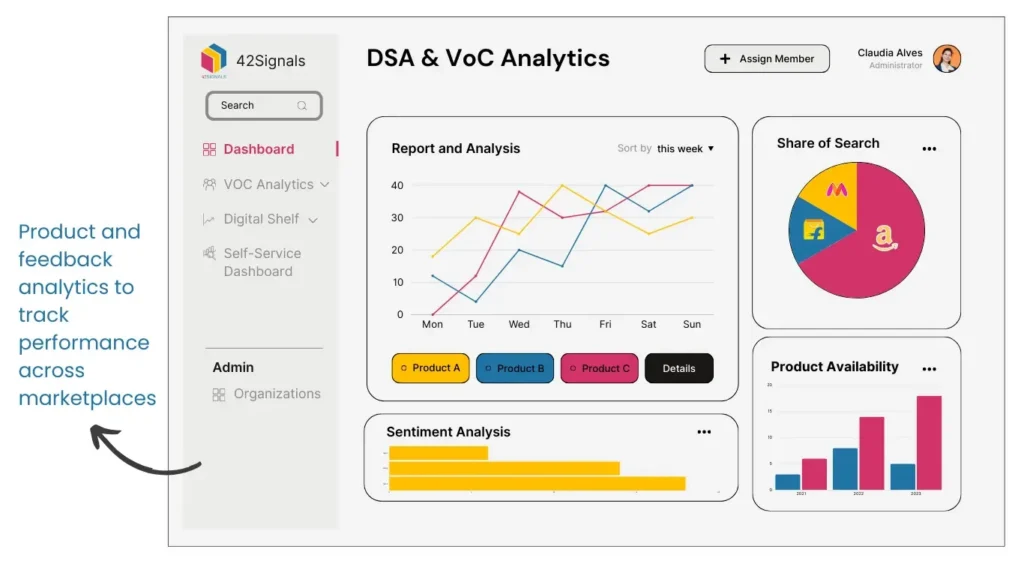
Data analysis can sometimes feel daunting, especially for those lacking technical expertise. Recognizing this challenge, 42Signals has crafted a self-service dashboard interface that emphasizes simplicity and intuitiveness.
Users unfamiliar with complex analytic tools will appreciate the streamlined design, which renders intricate datasets readily digestible. Moreover, the platform’s flexibility accommodates both basic and advanced functionalities, catering to diverse user requirements while preserving a uniformly positive user experience.
Unmatched Versatility
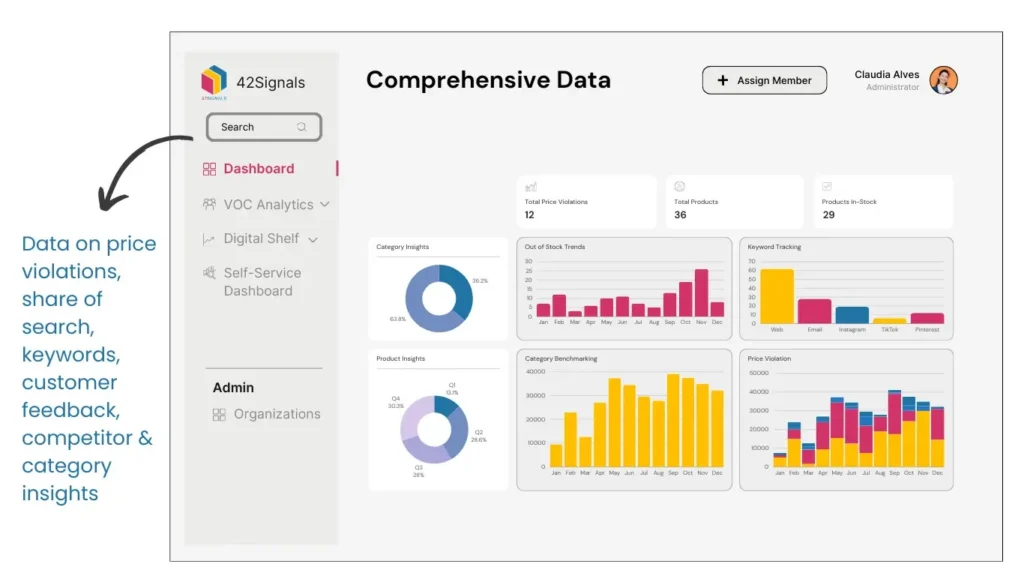
Whether operating a burgeoning startup or managing an established enterprise, businesses require price monitoring tools that scale effortlessly with their growing demands. 42Signals addresses this necessity by offering versatile custom service plans tailored to accommodate varying organizational scales.
Furthermore, its compatibility extends beyond mere pricing analyses; the platform encompasses features dedicated to MAP violation detection, and customer review aggregation, share of search analytics, and seller intelligence, solidifying its status as a holistic e-commerce solution.
Committed Customer Support
A company’s reputation hinges upon its capacity to address client concerns and queries effectively. In this regard, 42Signals provides attentive and proactive customer support.
Rather than relegating clients to automated responses or labyrinthine phone trees, representatives engage directly with users, fostering meaningful dialogues aimed at resolving pressing issues.
With advanced data scraping capabilities, 42Signals provides custom requirements that exactly suit the user’s needs. From providing the right data from websites – bestsellers, price fluctuations, product attributes, product characteristics changes and frequency, to much more. With decade-long expertise, the team answers all requirements.
42Signals helps businesses in several ways. Here are a few benefits of the platform –
- Visibility into key metrics: Instant access to crucial information such as competitive advantages, customer reviews, star ratings, product availability, category benchmarks, and price violations in the marketplace, leading to informed decision-making.
- Customizable analytics: Personalized data point selection according to individual organizational structures and objectives, moving away from a one-size-fits-all approach and generating targeted insights that drive action.
- Fair pricing across marketplaces: Ensuring consistent and equitable pricing throughout various platforms, eliminating discrepancies, and promoting trust among consumers.
- Competitive strategic planning: Harnessing competitor data to facilitate effective decision-making, minimize missed opportunities, and positively influence revenue generation.
- VoC analytics for competitive advantage: Using Voice of Customer (VoC) analytics to gain a deep understanding of customers’ preferences, desires, and behaviors, ultimately improving products, services, and securing a competitive edge within the industry.
- Enhancing customer satisfaction: Identifying improvement areas based on gathered customer feedback, thereby increasing customer satisfaction and strengthening loyalty.
- Cost savings and time efficiency: Reducing resource waste and minimizing manual tasks through automation, allowing users to focus on core business functions.
Ready to calculate what price monitoring could return for your specific catalogue? Schedule a demo today, and we’ll show you live price monitoring across your competitive set and help you model the margin impact for your category.
Frequently Asked Questions
How do you monitor pricing?
Monitoring pricing involves systematically tracking and analyzing the prices of your products and those of your competitors to make informed business decisions. Methods include:
Manual Tracking: Regularly visiting competitor websites and recording prices in spreadsheets. This method is labor-intensive and prone to errors.
Automated Price Monitoring Tools: Utilizing software solutions that automatically track and report competitor pricing. These tools provide real-time data, historical price trends, and alerts for price changes.
Why is it important for marketers to monitor the competition’s prices?
Monitoring competitors’ prices is crucial for marketers to:
Stay Competitive: Ensures pricing strategies are aligned with market standards, preventing loss of customers to lower-priced alternatives.
Identify Market Trends: Helps detect pricing trends and seasonal fluctuations, allowing for proactive adjustments.
Enhance Profit Margins: Enables optimization of pricing to balance competitiveness with profitability.
Inform Marketing Strategies: Provides insights into competitors’ promotions and discounts, aiding in the development of counter-strategies.
Maintain Brand Image: Ensures pricing reflects the brand’s positioning in the market, whether as a premium or budget option.
Which tool is best for competitor analysis?
When it comes to competitor analysis, 42Signals stands out as a top choice, especially for e-commerce businesses seeking comprehensive insights. This AI-powered platform offers a suite of features designed to help brands stay ahead in a competitive market:
Competitor Tracking: Monitor competitors’ product offerings, pricing strategies, and promotional activities in real time.
Digital Shelf Analytics: Gain insights into product visibility and positioning across various online platforms.
Customer Sentiment Analysis: Analyze customer feedback to understand market perceptions and identify areas for improvement.
Why should a marketer be aware of competitors’ prices?
Understanding competitors’ pricing is crucial for marketers for several reasons:
Competitive Positioning: Knowing where your pricing stands relative to competitors helps in positioning your products effectively in the market.
Profit Margin Optimization: Awareness of competitors’ prices enables you to set prices that maximize profits while remaining attractive to customers.
Market Trend Identification: Monitoring pricing trends can reveal shifts in consumer demand and emerging market opportunities.
Customer Perception: Pricing influences how customers perceive your brand; staying competitive ensures you meet their expectations
What are price monitoring tool criteria I should evaluate?
When evaluating price monitoring tools, assess these key criteria:
Coverage
How many competitor sites are monitored? Which marketplaces? Can they track international sites?
Accuracy
What’s their match rate? How do they handle product variants? Can they provide accuracy audits?
Freshness
How often are prices updated? Real-time? Daily? Weekly?
Usability
Is the dashboard intuitive? Can non-technical users navigate?
Alerts
Can alerts be customized by product, competitor, threshold?
Integration
Does it connect with your existing systems (ERP, CRM, repricing tools)?
Reporting
What reports are available? Can they be exported? Is historical data accessible?
Support
What’s included in onboarding? Ongoing support response times?
Cost
Transparent pricing? Scales with your business?
How do I set up ecommerce pricing alerts?
Setting up effective price alerts involves:
Prioritize products: Focus on top revenue drivers first
Identify key competitors: Select the 5-10 competitors that matter most
Set thresholds: Define what triggers an alert (e.g., “competitor price < our price by 5%”)
Configure exclusions: Suppress alerts during planned promotions or from irrelevant competitors
Route alerts: Decide who receives which alerts (pricing team, category managers, etc.)
Test and refine: Start with a pilot, then adjust thresholds based on alert volume
Best Practice: Start with fewer alerts and expand. Too many alerts create noise; too few miss opportunities. Find the balance through testing.
What’s the difference between price monitoring and repricing?
This is a common point of confusion:
Price Monitoring is about intelligence—collecting data on competitor prices to inform decisions. It answers “What are they charging?”
Repricing is about action—automatically changing your prices based on rules. It answers “What should we charge?”
Many tools offer both, but they’re distinct functions:
Monitoring feeds the decision process
Repricing executes the decision
Some businesses monitor first, then manually reprice. Others connect monitoring to automated repricing engines for real-time adjustments.
How many competitors should I monitor?
Quality over quantity. Most businesses benefit most from tracking:
5-10 direct competitors (selling identical or very similar products)
3-5 category leaders (Amazon, Walmart, category specialists)
2-3 regional/local competitors (if relevant)
For large enterprises, this may scale to 50+ competitors, but the Pareto principle applies: 80% of competitive insight comes from 20% of competitors. Focus there first.