
Performance Benchmarking Analytics for High-Performance Retail
In the fast-moving world of retail, simply knowing your own performance isn’t enough. To truly succeed and capture market share, you need to understand how you stack up against the competition. That’s where performance benchmarking analytics comes in. This comprehensive guide unveils the 2026 framework for leveraging advanced analytical models, Key Value Indicator (KVI) analysis, and rich datasets to craft high-performance retail strategies. We will take a deep dive into how leading retailers are moving beyond simple price comparisons to utilize sophisticated benchmark models that incorporate pricing strategy, real-time competitor data, and crucial marketplace insights. By mastering this framework, you’ll gain the necessary tools to optimize your operations, refine your market positioning, and drive superior financial results in the modern ecommerce analytics landscape. This article is your essential roadmap to turning raw data into decisive competitive action.
What Is Performance Benchmarking in Retail? (And Why It Goes Beyond Pricing)
The retail environment today is fundamentally different from even a few years ago. Digital transformation, the rise of powerful marketplaces, and increasingly savvy consumers have made the competitive landscape more complex and dynamic than ever before. In this environment, relying solely on internal metrics—like last quarter’s sales or year-over-year growth—is akin to driving while only looking in the rearview mirror. To navigate the future successfully, retailers must adopt a forward-looking, externally aware strategy. This is the core mandate of performance benchmarking analytics.
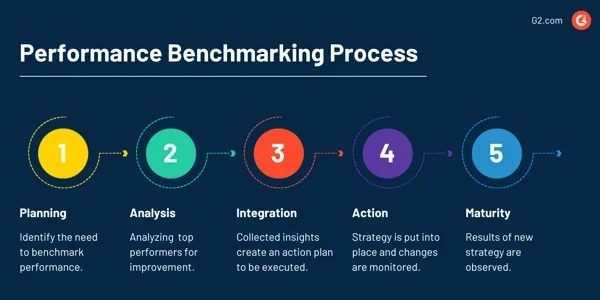
Image Source: G2
Performance benchmarking analytics is much more than just keeping tabs on what your competitors are doing. It’s a structured, continuous process of measuring your performance against the industry’s best, identifying performance gaps, and implementing strategies to close them. For the modern retailer, especially those operating in the volatile ecommerce analytics space, this process is non-negotiable for achieving sustained high performance. It allows businesses to move beyond guesswork and base critical decisions—from inventory management to pricing strategy—on concrete, verifiable retail pricing analytics data drawn directly from the market.
Imagine a retailer who notices their sales are dipping. Without effective performance benchmarking analytics, they might attribute this to a slow season or an internal operational issue. However, benchmarking might reveal that a key competitor has slashed their prices or significantly improved their delivery times, fundamentally shifting consumer expectations. This insight instantly transforms the problem from an internal mystery into an external competitive challenge, demanding a precise, market-informed response. This deep level of understanding is what the 2026 framework is designed to deliver.
Beyond Price Checks: What Modern Retail Benchmark Models Actually Measure
Historically, benchmarking often revolved around a narrow focus on price matching or basic assortment comparisons. While price remains a vital component, the 2026 framework dictates a holistic approach that acknowledges the multi-faceted nature of retail value. Modern performance benchmarking analytics integrates data points across the entire customer journey and digital shelf.
Three Benchmark Models Every Retail Team Should Be Running
The shift from simple to sophisticated analysis requires adopting advanced benchmark models. These are no longer static reports but dynamic systems that use artificial intelligence and machine learning to constantly ingest, process, and analyze massive volumes of competitor data.

- Assortment and Availability Benchmarking: Assortment and availability analytics goes beyond checking if a competitor stocks a product you sell. It involves analyzing the breadth, depth, and exclusivity of their entire product range. By continuously monitoring the digital shelf data of key competitors, retailers can quickly identify emerging product categories, understand where they have gaps, and make informed decisions on product expansion or rationalization. This continuous monitoring ensures a retailer’s offering remains competitive and relevant to evolving consumer demands.
- Customer Experience and Fulfillment Benchmarking: Performance extends well past the ‘Add to Cart’ button. Modern models benchmark crucial customer experience factors like website speed, mobile responsiveness, ease of checkout, and, critically, fulfillment metrics. This includes competitor shipping speed promises, return policies, and customer service response times. For instance, if a retailer’s average delivery time is 5 days, but most competitors are promising 2-day delivery, this massive gap in performance needs to be addressed immediately.
- Promotional and Markdown Benchmarking: The promotional price benchmarking model analyzes the frequency, depth, and duration of competitor promotions. It moves beyond simply tracking current sale prices to understanding the strategy behind their markdowns. Are they aggressively clearing inventory? Are they using introductory offers to drive adoption of a new product line? Analyzing these patterns provides critical context for refining one’s own pricing strategy and maximizing promotional effectiveness without unnecessary margin erosion.
These sophisticated benchmark models are essential because they provide a 360-degree view of market dynamics, ensuring that a retailer’s response is comprehensive and addresses the true drivers of competitor success.
KVI Analysis: How to Prioritise the Metrics That Actually Drive Market Share
To avoid drowning in a sea of data, effective performance benchmarking analytics must focus on Key Value Indicators (KVIs). Unlike Key Performance Indicators (KPIs), which focus on internal metrics, KVIs are the specific, high-impact factors that directly influence a customer’s decision to purchase from one retailer over another.
What Makes a Metric a KVI?
A KVI is a competitive lever that, when managed effectively, disproportionately impacts market share and profitability. Focusing on KVIs ensures that benchmarking efforts are strategically aligned with revenue generation.
Here are three core areas for KVI analysis in retail, providing the necessary depth for high-performance strategies:
- Competitive Pricing Position (CPP): While simple price matching is outdated, understanding your price positioning relative to the market average and specific key competitors remains a KVI. This analysis should measure the percentage of your assortment priced below, at, or above key rivals, specifically focusing on your top-selling products. A granular CPP analysis informs your pricing strategy by revealing where you have permission to charge a premium and where you must be competitive.
- Time-to-Digital Shelf (TTS): In the modern retail environment, speed matters. TTS measures the time it takes for a new or restocked product to move from arrival in the warehouse to being accurately listed and available for purchase on your website and relevant marketplaces. Benchmarking this metric against competitors, particularly fast-moving rivals in the ecommerce analytics sector, highlights operational bottlenecks that could be costing you first-mover advantage and market share.
- Search Ranking Visibility (SRV): Where your products appear on search results—both internal site search and external marketplace search (like Amazon)—is a critical KVI. If a competitor consistently ranks higher for your shared primary keyword, they are capturing traffic and sales that you are missing. Share of search analytics analyzes product listing optimization, content quality, and sales history to uncover the hidden mechanisms that drive superior visibility on the digital shelf data. This information is vital for maximizing organic traffic and conversion rates.
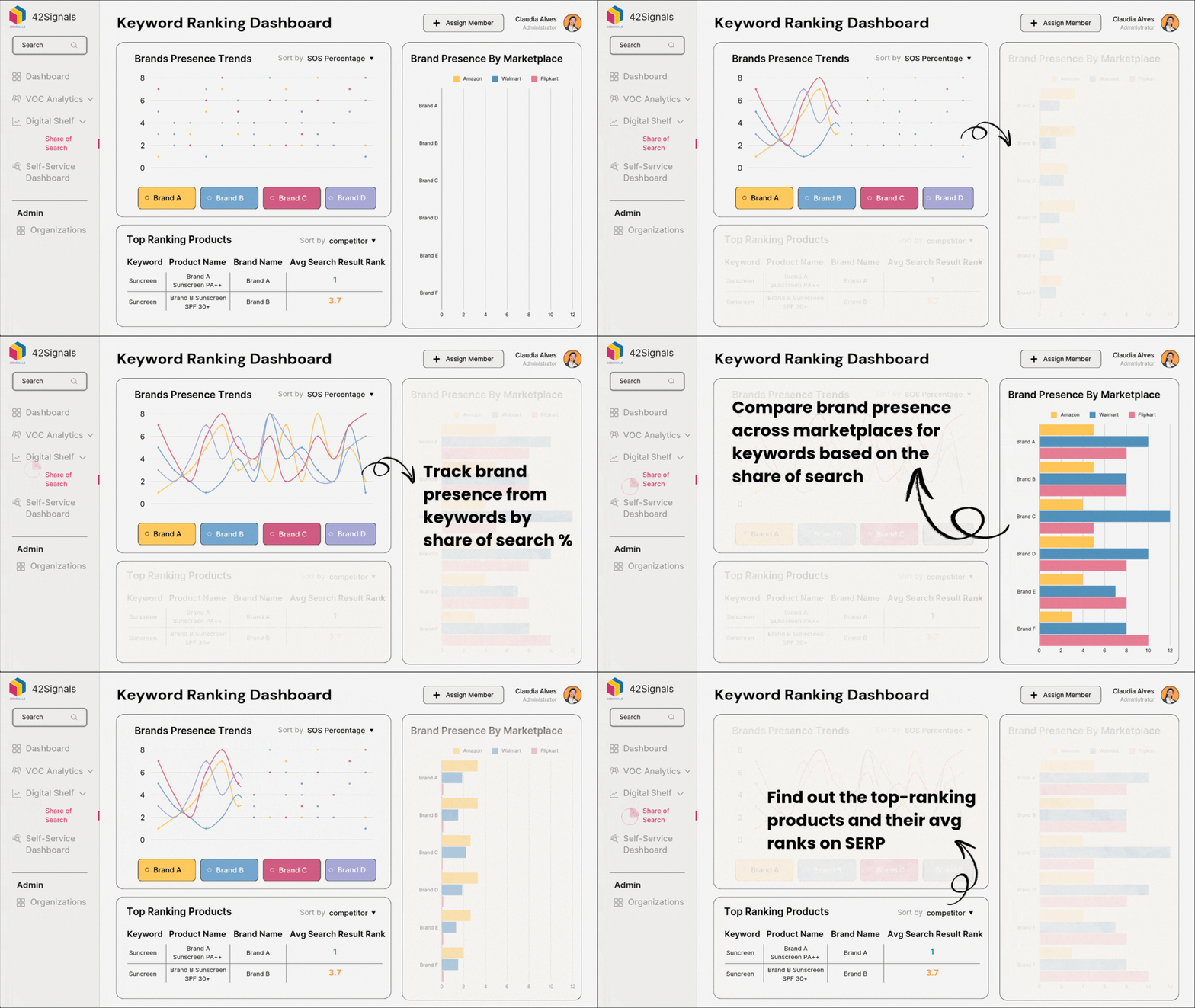
By zeroing in on these and other relevant KVIs, retailers can prioritize the gaps that, when closed, will yield the highest return on investment.
Ready to transform your pricing and assortment strategies using the latest in dynamic market intelligence? Click here to schedule a personalized demo of our Retail Analytics Platform and see the 2026 framework in action
Three Data Streams That Power Retail Benchmarking Analytics
The quality of your insights is directly proportional to the quality and breadth of the datasets you use for your performance benchmarking analytics. The 2026 framework emphasizes the integration of three distinct, powerful data streams.
1. Marketplace Insights: Unlocking the Competitor Data Goldmine
Marketplaces like Amazon, eBay, and specialty platforms are often the single largest source of transactional data and product visibility in the modern retail landscape. Mining these platforms for marketplace insights with marketplace price intelligence offers an unparalleled view of competitive dynamics.
- Sales Rank Data: Tracking sales rank trends for shared products provides a proxy for competitor sales velocity and market traction.
- Review and Rating Data: Analyzing the volume and sentiment of competitor product reviews offers qualitative insights into product quality, customer satisfaction, and service delivery failures. This qualitative competitor data is invaluable for refining your own product offerings and service protocols.
- Fulfillment Benchmarks: Marketplaces often clearly state fulfillment methods (e.g., FBA vs. FBM). Analyzing the fulfillment choices of successful competitors reveals best practices for inventory positioning and logistics.
Source Insight: According to a 2025 analysis by Digital Commerce 360, over 60% of product searches begin on marketplaces like Amazon, underscoring the critical need to leverage this data source for accurate performance benchmarking analytics.
2. Digital Shelf Data: The Source of Truth for Assortment and Pricing
The digital shelf data—the real-time, structured information available on competitor websites—is the backbone of accurate benchmarking. This dataset includes current pricing, stock availability, product descriptions, images, and category placements.
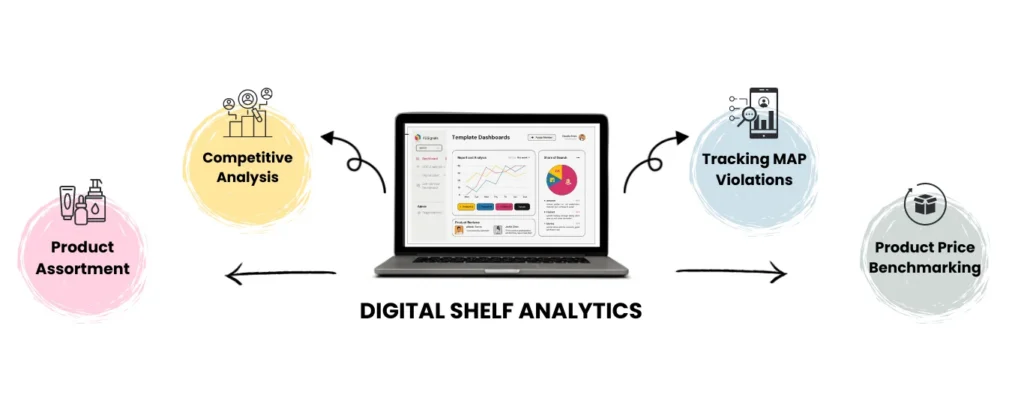
The key to leveraging this data is scale and speed. Modern platforms utilize advanced web crawling and AI-driven data extraction to capture millions of data points hourly. This constant stream of fresh, verifiable competitor data is what enables dynamic pricing strategy adjustments and ensures your market positioning is always based on the most current competitive reality. Without real-time digital shelf analytics, a retailer is simply reacting to stale information, often missing crucial windows of opportunity.
3. Internal Data Correlation: Contextualizing External Insights
The most powerful benchmark insights emerge when external competitor data is correlated with internal retailer data through ecommerce pricing analysis. This fusion helps answer the crucial “Why?” behind performance gaps.
| External Benchmark Data | Internal Retailer Data | Resulting Strategy Insight |
|---|---|---|
| Competitor Price Drops on Product X | Internal Sales Volume for Product X | If internal sales drop after the competitor drop, the competitor’s pricing strategy is the key driver. Immediate competitive pricing adjustment is necessary. |
| High Competitor Stock Availability | Internal Inventory Levels | If a competitor has high stock and you are running low, this highlights a failure in supply chain management or forecasting, impacting your market positioning. |
| Competitor High Search Visibility | Internal Product Content Quality | If the competitor ranks better, review and enhance internal product titles, descriptions, and metadata based on their successful keyword usage, optimizing your ecommerce analytics. |
This correlation is the advanced application of performance benchmarking analytics, turning raw data into strategic, actionable intelligence.
How Benchmarking Defines Your Market Positioning
With the datasets and benchmark models in place, the focus shifts to execution. High-performance retail requires turning insights into immediate, effective action, particularly concerning market positioning and pricing strategy.
Refining Market Positioning with Benchmarked Insights
Market positioning is about defining who you are to the consumer relative to the competition. Benchmarking provides the objective data needed to make this definition accurate and impactful.
- Defining the Value Spectrum: By analyzing competitor data across product quality, customer experience, and pricing, a retailer can determine if they are positioned as a premium provider, a budget leader, or a value-driven middle ground. If the data shows competitors are consistently offering better delivery speeds at the same price point, your current value proposition is weak, forcing a decision to either reduce price or improve fulfillment dramatically to justify your current market positioning.
- Identifying White Space Opportunities: Performance benchmarking analytics can reveal product categories or geographical regions where competitors are underserving the market (the ‘white space’). For example, analysis might show that no major competitor offers eco-friendly packaging in a specific category. A retailer can then strategically launch an assortment tailored to this gap, creating a defensible and profitable new market positioning.
Dynamic Pricing Strategy: Rule-Based and Elasticity-Informed Approaches
A modern pricing strategy must be dynamic, responsive, and informed by real-time performance benchmarking analytics. Sticking to fixed markups is a fast track to irrelevance.
- Rule-Based Pricing: This approach involves dynamic pricing in retail by setting predefined rules that automatically adjust prices based on real-time competitor data. For example, a rule might state: “If competitor A’s price on KVI product Y is lower than ours by more than 5%, drop our price to 3% below theirs, but never below a set minimum margin.” This provides a systematic way to maintain competitive relevance while protecting profitability.
- Elasticity-Informed Pricing: Advanced ecommerce analytics tools with price elasticity analysis can use historical sales data correlated with competitor price movements to estimate the price elasticity of demand for key products. This allows the retailer to understand how much sales will increase if they lower the price and, crucially, if the increased volume will offset the margin loss. This level of sophistication transforms pricing strategy from guesswork into precise financial engineering.
Stop guessing and start strategizing. If you are ready to implement a sophisticated, data-driven pricing strategy that adapts in real-time, book a personalised platform demo. We will show you how to leverage advanced performance benchmarking analytics to maximize your margins and market share.
A Four-Phase Roadmap for Implementing Retail Benchmarking Analytics
Implementing a comprehensive performance benchmarking analytics framework is a project that requires clear steps and dedicated resources. It is a long-term commitment, not a one-off report.
| Phase | Description | Key Deliverables & Activities |
|---|---|---|
| Phase 1: Foundation and Scoping | Define the scope and objective. Focus on key product categories and the most important competitors. | Define LOB: Clearly articulate the business objective (e.g., increase market share in Product Category Z by 5%). Identify KVIs: Select the 3-5 most impactful Key Value Indicators. Competitor Mapping: Identify 5-10 direct and aspirational competitors for benchmarking. |
| Phase 2: Data Acquisition and Integration | Establish reliable, scalable data pipelines to capture necessary external and internal data. | Digital Shelf Integration: Implement tools for collecting real-time digital shelf data and competitor data. Internal Data Pipeline: Ensure seamless data flow between internal systems (POS, ERP, Inventory) and the analytics platform. Dataset Validation: Clean and validate all incoming data streams to ensure accuracy for ecommerce analytics. |
| Phase 3: Model Development and Analysis | Build the necessary benchmark models and run initial analysis to identify performance gaps. | Benchmark Model Implementation: Develop models for Assortment, Fulfillment, and Promotional Benchmarking using competitor price monitoring tools. Gap Analysis: Produce an initial report highlighting the retailer’s position relative to competitors across all defined KVIs. Pricing Strategy Review: Use initial findings to identify immediate necessary adjustments to the existing pricing strategy. |
| Phase 4: Action and Optimization | Implement strategic actions based on insights and establish a continuous monitoring cycle. | Strategic Response: Implement changes to market positioning, refine product assortment, and adjust fulfillment processes. Dynamic Pricing Implementation: Roll out rule-based or algorithmic pricing changes informed by performance benchmarking analytics. Continuous Reporting: Set up daily or weekly reports to track KVI performance and competitor movements, ensuring sustained high performance. |
This roadmap provides a structured approach to integrating sophisticated performance benchmarking analytics into the fabric of your retail operations.
Conclusion: Sustaining High Performance Through Continuous Benchmarking
The retail industry is defined by constant change. The Mastering Performance Benchmarking Analytics: The 2026 Framework is built on the premise that sustained success depends on an organization’s ability to not only react quickly but to anticipate and proactively shape the competitive environment. By diligently applying the principles of deep benchmark models, focused KVI analysis, and the integration of rich datasets—especially competitor data, marketplace insights, and digital shelf data—retailers can move from being passive market participants to dynamic market leaders.
Mastering performance benchmarking analytics provides the crucial intelligence needed to optimize every facet of your business, from your pricing strategy to your market positioning. This is the pathway to building a resilient, high-performance retail organization ready to thrive in the complex landscape of today and tomorrow. The data is available; the framework is established. The only remaining step is action.
Frequently Asked Questions (FAQs) About Performance Benchmarking Analytics
What is the primary difference between a KPI and a KVI in retail benchmarking?
A KPI, or Key Performance Indicator, typically measures internal operational health, such as conversion rate, average order value, or inventory turnover. A KVI, or Key Value Indicator, is a metric used in performance benchmarking analytics that measures a retailer’s performance relative to the competition in areas that critically influence a customer’s purchasing decision.
How often should a retailer update their performance benchmarking analytics?
For high-performance retail, particularly in the fast-moving ecommerce analytics sector, benchmarking should be a continuous, real-time process. Critical metrics like pricing and stock availability (digital shelf data) should be monitored and updated daily or even hourly.
Is performance benchmarking analytics only about pricing?
No, while pricing strategy is a critical component, modern performance benchmarking analytics is far more holistic. It encompasses a 360-degree view of the competitive landscape, including assortment range, product quality (inferred from reviews), customer experience, fulfillment speed, and promotional activity.
What are the key challenges when collecting competitor data?
The main challenges in collecting accurate competitor data include data volume and complexity, maintaining data cleanliness and accuracy, and bypassing competitor anti-scraping measures. Furthermore, accurately correlating external marketplace insights with internal performance metrics requires sophisticated data integration tools.