


What is E-Commerce Category Management
Category management is the process of organizing and optimizing your online store’s categories, subcategories, and product listings to make it easier for customers to find what they’re looking for. When done correctly, effective category management can lead to increased customer satisfaction, higher conversion rates, and ultimately, better online visibility. So, how can you master e-commerce category management and give your online store the boost it needs?
The Strategic Role of E-Commerce Category Management
While the foundational steps of organizing products into logical groups are essential, modern e-commerce category management has evolved into a sophisticated, strategic discipline. It is the retail equivalent of curating a physical store’s layout and inventory, but with the added power of data and dynamic personalization. At its core, it is a strategic framework for managing a group of related products as a strategic business unit to maximize sales, profitability, and customer satisfaction.
This goes far beyond simple organization. Effective category management is the bridge between your merchandising strategy, your marketing efforts, and your customers’ journey. It directly influences key performance indicators (KPIs) such as conversion rate, average order value (AOV), and customer lifetime value (LTV). A poorly managed category creates friction, leading to high bounce rates and abandoned carts. A well-managed one guides the customer effortlessly from discovery to purchase, while simultaneously upselling and cross-selling related items.
The Data-Driven Foundation: Beyond Gut Feelings
The initial step of “conducting thorough research” is the bedrock of strategic category management. This research must be continuous and data-centric, moving beyond basic competitor analysis to a deep dive into multiple data streams:
- Internal Data: This is your most valuable asset. Analyze site search data to understand what terms customers are using. High-volume searches for terms not reflected in your category structure represent a critical gap. Track navigation paths using tools like Google Analytics to see how users flow through your categories. Where do they drop off? Which categories have the highest engagement? Sales data is equally crucial—identify your star performers, sleepers, and underachievers within each category.
- Customer Data: Leverage customer reviews, feedback forms, and survey responses. Are customers consistently complaining that a category is hard to navigate or that products are miscategorized? This qualitative data provides context to the quantitative numbers.
- External Market Data: Utilize tools like Google Trends, market research reports, and social listening platforms to understand broader consumer interests and emerging trends. If a new sub-niche is gaining popularity, being the first to create a dedicated subcategory for it can position you as a market leader.
The Category Management Lifecycle: A Continuous Process
Category management is not a one-time project but an ongoing cycle of planning, implementing, reviewing, and refining. This lifecycle can be broken down into several key phases:
- Definition and Role Assignment: The first step is to define the scope of each category. More importantly, each category should be assigned a strategic role that aligns with overall business objectives. Common roles include:
- Destination Categories: These are your core offerings that drive traffic and define your brand (e.g., “4K Gaming Monitors” for a tech store).
- Routine Categories: Everyday essentials that customers expect you to carry (e.g., “HDMI Cables” or “Monitor Stands”).
- Convenience/Niche Categories: These items enhance the shopping experience and can increase AOV (e.g., “Gaming Chair Accessories”).
- Seasonal Categories: Products that are relevant for a limited time (e.g., “Holiday Gaming Bundles”).
- Category Assessment and Scorecarding: This is where data takes center stage. Create a scorecard for each category that tracks a balanced set of KPIs. This should include:
- Traffic Metrics: Page views, unique visitors, traffic source.
- Conversion Metrics: Conversion rate, add-to-cart rate.
- Financial Metrics: Sales revenue, profit margin, sell-through rate, AOV.
- Product Performance: Identify winners, losers, and gaps in the assortment.
- Customer Metrics: Return rates, customer satisfaction scores (CSAT).
- Category Strategy and Tactics: Based on the assessment, develop a tailored strategy for each category. For a high-traffic, low-conversion “Destination Category,” the strategy might be to improve product content with videos and 3D models. For a “Routine Category,” the goal might be to optimize for profitability and ensure it appears as a frequently bought-together item. Tactics here include pricing strategies, promotional plans, and merchandising execution (like the placement of products on the page).
- Implementation and In-Store Execution: This is the practical application of your plan—creating the categories and subcategories on your website, optimizing the product listings with the right keywords and images, setting up the recommended filters (price, brand, features), and integrating cross-selling widgets.
- Review and Replenishment: The cycle closes with a rigorous review. Compare the category’s performance against its scorecard. Have the implemented changes moved the needle? Use A/B testing to experiment with different category layouts, product ordering (by bestseller, price, rating), and promotional banners. This phase also involves ongoing assortment planning, discontinuing poor performers, and introducing new products to fill identified gaps.
Here are some tips to get you started:
Conduct thorough research in e-commerce category management
Before you start organizing your categories, it’s important to conduct thorough research into your target audience and their shopping habits. Look at industry trends, analyze your competitors, and identify gaps in the market that you can fill with your products. This will help you create categories that resonate with your target audience and increase the chances of them finding what they’re looking for.
Create clear and concise categories
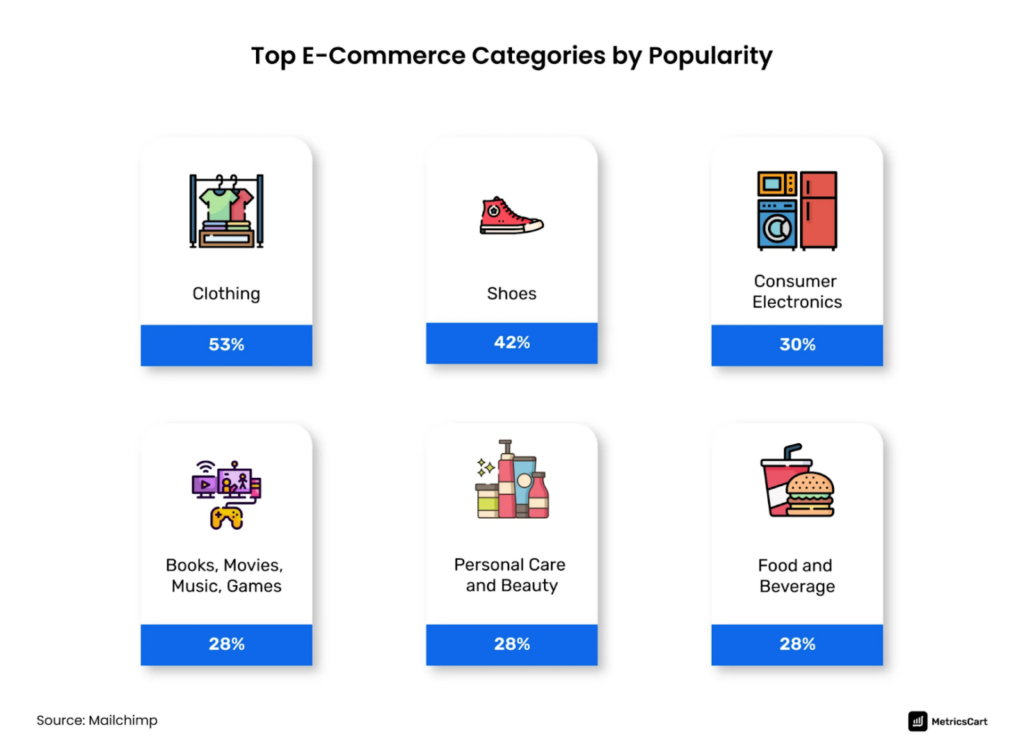
Image Source: MetricsCart
Once you have a good understanding of your target audience, it’s time to create clear and concise categories that reflect their shopping habits. Avoid using jargon or technical terms that might confuse customers. Instead, use simple language that accurately describes the types of products they’ll find within each category.
For example, if you sell clothing, instead of creating a category called “outerwear,” consider creating separate categories for “jackets,” “coats,” and “vests.”
Use subcategories to refine search results
Subcategories allow you to further refine search results and provide customers with more specific options. Continuing with our clothing example, under the “jackets” category, you could create subcategories like “leather jackets,” “denim jackets,” and “windbreakers.” This helps customers quickly narrow down their search and find exactly what they want.
Optimize product listings
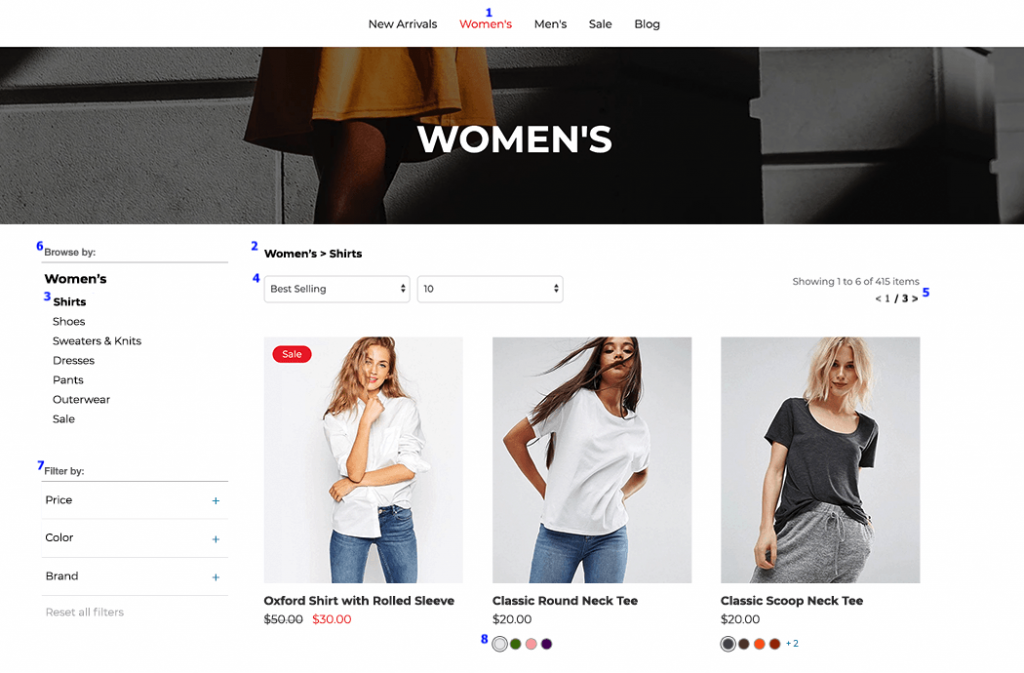
Image Source: Dynamic Yield
Optimizing your product listings is crucial for increasing visibility and driving sales. Make sure each listing includes high-quality images, detailed descriptions, and relevant keywords. Also, ensure that your product titles accurately reflect the name of the product and include any relevant information, such as size, color, or material.
Utilize filters and faceted navigation

Image Source: Searchspring
Filters and faceted navigation allow customers to further refine their search results based on specific attributes, such as price, brand, or size. By providing these tools, you can help customers quickly find the exact product they’re looking for and reduce the likelihood of them leaving your site frustrated.
Regularly review and update categories
As your business evolves and new products are added, it’s essential to regularly review and update your categories to ensure they remain relevant and useful to customers. Consider analyzing customer feedback, search data, and sales patterns to determine which categories are working well and which ones need improvement.
Invest in SEO optimization for e-commerce category management
Search engine optimization (SEO) plays a critical role in e-commerce category management. Ensure that your categories, subcategories, and product listings are optimized for relevant keywords and phrases to improve your site’s visibility in search engines. Additionally, use meta tags and descriptions to provide search engines with additional context about your content.
Provide excellent product recommendations
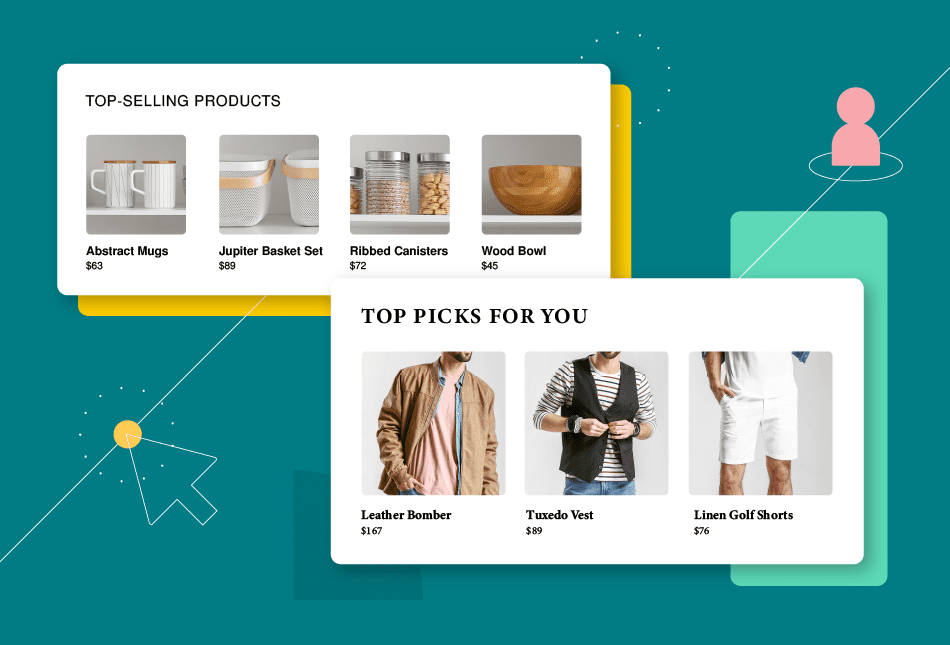
Image source: Monetate
Product recommendations can be a powerful tool for encouraging customers to explore related products and increase average order value. Use algorithms and machine learning to suggest products that complement the items customers are viewing or have previously purchased. Personalized recommendations not only enhance the customer experience but also increase the chances of repeat business.
Offer intuitive navigation
Intuitive navigation is key to ensuring customers can easily find what they’re looking for. Use clear and consistent menu structures, and consider implementing features like breadcrumb trails and “related categories” sections to help customers navigate your site with ease.
Monitor performance and adjust accordingly
Finally, monitor your category performance regularly and adjust your strategy as needed. Analyze metrics like page views, click-through rates, and conversion rates to determine which categories are performing well and which ones require improvements. Use this data to refine your categories, optimize product listings, and enhance the overall customer experience.
Mastering e-commerce category management requires careful planning, attention to detail, and a willingness to adapt to changing customer preferences.
These tips are meant to help you optimize your e-commerce presence and win more sales. For any questions on e-commerce analytics or to know more about how it can help your business, schedule a demo with us today.
The Power of Technology: Automation and AI
Modern category management at scale is impossible without leveraging technology. E-commerce platforms and specialized software now offer powerful tools to automate and enhance the process:
- Product Information Management (PIM) Systems: A PIM acts as a single source of truth for all product data, making it exponentially easier to manage and update product attributes across thousands of SKUs, which is essential for accurate filtering and faceted navigation.
- AI-Powered Merchandising Tools: These platforms use machine learning to dynamically optimize category pages. Instead of a static “sort by bestselling,” AI can personalize the product order for each user based on their browsing history, location, and behavior. It can also automate product recommendations within categories, ensuring that “customers who viewed this also viewed…” suggestions are highly relevant.
- Dynamic Filtering: Advanced filtering goes beyond price and brand. It can include product attributes like “material,” “battery life,” “screen refresh rate,” or “occasion,” all pulled directly from the PIM. This empowers customers to find their perfect product through a process of elimination, drastically improving the user experience.
Organizational Alignment: The Role of the Category Manager
In larger e-commerce organizations, category management is often overseen by a dedicated Category Manager. This individual acts as the “CEO” of their assigned categories. Their responsibilities are multifaceted, requiring a blend of analytical and creative skills:
- Financial Acumen: They are responsible for the P&L of their category.
- Analytical Prowess: They must be adept at interpreting complex data sets to make informed decisions.
- Merchandising Eye: They need a strong sense of how to visually merchandise a digital shelf to tell a compelling story and drive sales.
- Vendor Management: They often negotiate with suppliers and brands within their category for better pricing, exclusive products, and cooperative marketing funds.
- Customer Advocacy: Above all, they must be the voice of the customer for their category, ensuring that the shopping experience is intuitive and satisfying.
The Future of E-Commerce Category Management: Hyper-Personalization and Voice Commerce
As technology advances, so too will category management. Two key trends are poised to reshape it further:
- Hyper-Personalized Category Pages: The future lies in moving away from a one-size-fits-all category structure. Using AI, websites will dynamically generate category pages tailored to the individual user. A returning customer interested in budget-friendly options might see a “Laptops Under $500” category highlighted, while a high-value customer might see a “Premium Ultrabooks” category. The very structure of the navigation will become fluid and adaptive.
- Voice Commerce and Visual Search: The rise of voice assistants (like Alexa and Google Assistant) and visual search (like Google Lens) requires a rethinking of category taxonomy. Customers using voice search use natural language (“Show me durable running shoes for trail hiking”). Your product data and category structure must be semantically rich enough for these AI systems to understand and match these conversational queries accurately.
Frequently Asked Questions in E-Commerce Category Management
What are the 4 P’s of category management?
Product: This involves selecting items or offerings that meet the demands and expectations of consumers.
Price: Refers to the cost of the products offered and the price paid to vendors, emphasizing value.
Place: Also known as placement, it’s about how accessible and appealing your product offering is to consumers.
Promotion: Involves marketing strategies to get consumers excited about the product offerings.
What are the 3 types of category management?
Exclusive: A retailer carries products from only one supplier in a product category.
Selective: Products from multiple suppliers are carried in a product category.
Non-Selective: Products from all suppliers are carried in a product category.